Retail Digital Transformation: Turn Every Store into One Connected Growth Engine
We all know what digital transformation means. But what does it actually look like in retail?
In simple terms, retail digital transformation is about bringing the different parts of your business together so they work as one. Your stores, warehouses, online channels, inventory, sales and customer information all become part of one connected operation. And as Saudi Arabia’s economy grows under Vision 2030, more retailers are making that move.
Think about a typical day in retail. A customer checks a price on your website, then walks into your store expecting the same offer. A store manager wants to know whether a bestseller is available at another store. Finance needs the latest sales figures. And your team needs all this information to make decisions and keep things moving.
Now imagine having all of that information connected, accessible and working together.
That’s the real value of retail digital transformation. It’s about making it easier to manage your entire retail business, see what’s happening across every part of it and make better decisions as you grow, whether you’re adding new software or building on the systems you already have.
So, what does that transformation look like in practice? And more importantly, where should you start? In this blog, we’ll walk you through five practical steps.
Three Upgrades That Let Your Stores Grow Faster
Your till is built to do one thing: ring up sales at the counter. That works fine at first. But when you open more stores, start selling online, and add a loyalty programme for your top customers, you need every part of your business connected, so each store shares the same numbers and you can follow your whole business as it grows. That’s why you need three things.
1. One Version of the Truth
When your POS, stock and online store all read from the same database, everyone sees the same numbers. Your store managers and your finance team spend less time comparing spreadsheets and more time making decisions. And your customer gets the same answer in store as they got online: same prices, same discounts, same loyalty points.
2. More Budget for Growth, Less for Maintenance
Think of it this way: every separate system needs its own resources, updates and a team to keep it up and running. Bring all your systems onto one platform and your costs begin to shrink. The budget you free up can go straight into new stores, new products or even better service. (We break down the numbers in our guide to the true value of unified retail platforms.)
3. Decisions in Minutes, Not at Month-End
Let’s say you have stores in Riyadh and Jeddah. When you can see today’s sales and stock as they happen, you can act on them straight away. If stock is running lower in Jeddah than in Riyadh, you can move it to the store that needs it. You can push a slow line before the weekend, or call a manager while there’s still time to make a difference. That’s what multi-store retail management looks like day to day.
So What is Retail Digital Transformation?
There’s a lot of jargon around this topic, so here’s the simple version.
Retail digital transformation means running your POS, inventory, operations and customer data on one connected platform. A sale in Riyadh updates your stock in Jeddah, your reports at head office and your customer’s loyalty points, all at once. Your stores go from working side by side to working together.
The Four Foundations of a Retail Business Built to Scale
If you think about it for a while, every connected retail business rests on the same four foundations. Get these right and everything else gets easier.
1. One Platform Running Your Whole Operation
This is the base everything else sits on. Instead of five tools that each see part of the picture, you have one system that sees it all.
- A POS system that keeps selling: Your tills work online and offline, so the queue keeps moving even when the connection drops.
- Live stock, everywhere: You can check stock across your warehouses, stores and online channels from one place. Here’s more on inventory management in the digital era.
2. AI That Tells You What to Do Next
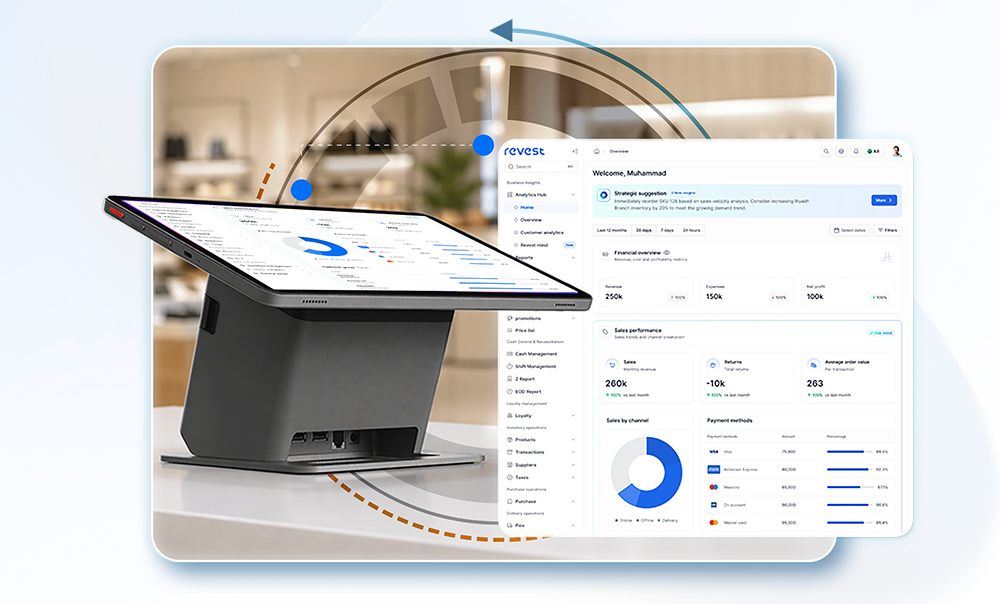
Reports tell you what happened. AI helps you decide what happens next. With Revest Mind, your data turns into forecasts and timely nudges your managers can act on.
- Demand forecasting: AI estimates what will sell, and when, based on your own sales history.
- Early alerts: You hear about a product running low or close to expiry while there’s still time to act.
3. One Customer, Every Channel
Your customer doesn’t think in channels. They think about your brand. When their profile and loyalty points follow them from your website to your store and into your app, every visit feels like they’re picking up where they left off.
4. Compliance That Runs Itself
Compliance should happen in the background while your team serves customers. Every invoice is compliant with ZATCA e-invoicing automatically, and each till reconciles at the end of the day, so your sales and payments line up without the late-night checks.
What You Gain When Your Stores Work as One
So what does all this add up to? Here’s what retailers notice first once their systems are connected.
- Lower costs: Less cash tied up in slow stock, and fewer hours spent on manual work.
- Faster expansion: A new store goes live on the same platform as the rest, with the same products, prices and rules from day one.
- Cleaner books: Sales, stock and tax data flow to finance automatically, so month-end closes faster.
Your 5-Step Plan to Get Started
Digital transformation sounds big, but it’s really a series of sensible steps. You don’t have to do it all at once. Here’s the order we’d recommend.
Step 1: Take an Honest Look at Where You Are
Before you change anything, get a clear picture of today. It takes an afternoon and saves months later. Ask yourself:
- What are we using? List every system for sales, stock, finance and online.
- Where does the time go? Which tasks eat up your team’s week?
- Can I see today’s profit, by store, right now? If the answer is “not quite”, that’s your starting point.
Step 2: Pick the Platform You’ll Grow With
This is the big decision, so don’t just look at the feature list. You’re choosing the core your business will run on for years. Three things matter most:
- Cloud-native: Every store runs on the latest version, with nothing to install on site. (Still deciding? Compare cloud and local POS.)
- Open API: It connects to your existing ERP, online store and payment terminals.
- Built to scale: Adding a store or a till is quick and simple.
Step 3: Clean Your Data Before You Move It
If you’re moving houses, you’ll start out by clearing out the cupboards. The same goes for your data. Tidy up your product codes, customer records and supplier details first, and your new system will give you accurate reports and sharper forecasts from day one.
Step 4: Bring Your Team With You
Here’s the part people underestimate: transformation is mostly about people. Pick a system your cashiers can learn in a shift, train early, and celebrate the first quick wins out loud.
Step 5: Trade Reports for Real-Time Signals
End-of-day reports tell you what already happened. Signals tell you while you can still act. It’s a big part of operational excellence in retail. Set alerts for the moments that matter most to you: a bestseller running low, a product near expiry, or a store that’s beating its target.
How Leading Retailers Are Putting It to Work
Every sector has its own priorities, so transformation looks a little different depending on what you sell. Here are three examples.
Pharmacies
Expiry dates and regulations come with the territory. Connected stock records help you track both closely, and keep essential products on the shelf.
Furniture and Building Materials
Big orders, bulky stock and delivery schedules all need to line up. One platform keeps your showroom, warehouse and delivery team working from the same order.
Auto Parts
With thousands of near-identical parts, speed matters. Clear product data helps your team find the right part, or the right alternative, in seconds.
The 4 Numbers That Prove It’s Working
How do you know your transformation is paying off? Keep an eye on these four numbers. If they move in the right direction, you’ll know you’re on track.
- Out-of-stock rate: How often customers find what they came for.
- Team productivity: How many hours you save on manual data entry.
- Inventory turnover: How quickly your stock turns into sales.
- Reconciliation accuracy: How closely your sales, payments and accounts match.
Vision Is What Turns Technology into Growth
Technology is the tool. Vision is what makes it pay. The retailers who grow fastest pick a partner who understands where they’re heading, as well as how they run today, and a system that gives them control from the till in each store to the AI insights at head office. It’s where the future of retail is heading.
Your Next Move Toward Market Leadership
Now that we’ve gone through the details of retail digital transformation, which step is right for you? Here are three to start with:
- Name your three biggest operational challenges. That’s where you’ll see results first.
- Make integration non-negotiable. Every system you choose should talk to the rest of your business.
- Choose for five years from now. Pick a platform that can keep up with the stores and channels you’re planning to add.
As the leading retail platform in Saudi Arabia and the GCC, we’ve helped more than 200 businesses connect their operations and grow with confidence.
Ready to see your stores, stock and customers working as one? Get started with Revest now.